

Malbolge is widely considered the most difficult coding language ever created by design.
If you want a clear, expert take on the most difficult coding language, you are in the right place. I’ve spent years working with languages that push the limits of the mind and the machine. In this guide, I break down what makes a language hard, which ones deserve the “most difficult coding language” label, and how to approach them with confidence. You will get real examples, honest advice, and a practical plan to learn faster and avoid frustration.

What “most difficult coding language” really means
“Difficult” is not one thing. It can mean different hurdles for different people. To judge the most difficult coding language, you should look at a few core traits.
- Syntax complexity. Does the code look cryptic or long? Are there strange symbols?
- Mental model. Do you think about logic, time, or data in a new way?
- Tooling and ecosystem. Is there good documentation, IDE help, and community support?
- Error feedback. Do compilers or interpreters give clear hints?
- Performance constraints. Do you have to manage memory or hardware details by hand?
These factors shape the learning curve. A language can be hard by design. Or it can be hard because it solves hard problems. This is why the most difficult coding language depends on your goal.

Esoteric vs practical: two kinds of “hard”
You will hear two answers when people ask about the most difficult coding language.
- Esoteric languages. These are built to be puzzles. The goal is not real apps. The goal is to play with your brain.
- Practical languages. These are used in real products. The challenge comes from safety, speed, or huge feature sets.
If you want a pure answer to “most difficult coding language,” Malbolge or Brainfuck often win. If you want a real-world answer, C++, Rust, and Haskell are strong picks. You should decide which lens you need. That choice shapes your path.
Top contenders for the most difficult coding language
Below are languages that often appear when people debate the most difficult coding language. I group them by use and by type of difficulty.
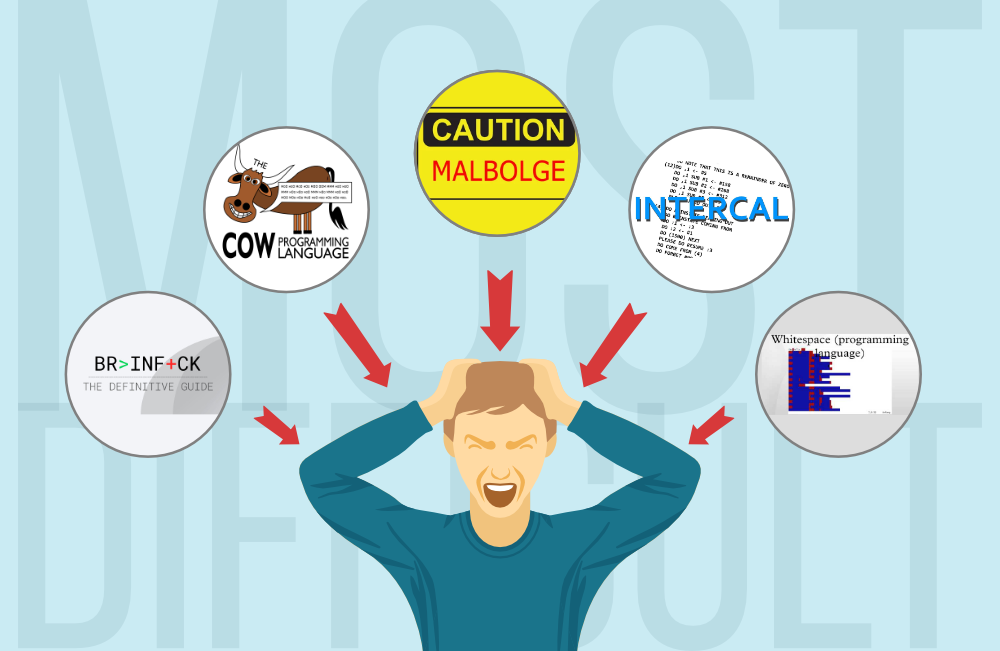
- Malbolge. Esoteric. Designed to be almost impossible to program by hand. Self-modifying rules make it wild.
- Brainfuck. Esoteric. Only eight commands. But hard to read and write. You must track a moving memory pointer.
- Intercal. Esoteric. Intentionally weird syntax. A parody that still works.
- APL/J/K. Array languages. Use symbols and dense expressions. Powerful, but the notation is tough at first.
- Haskell. Functional. Pure, lazy, strong types. The type system is deep. Abstractions are steep to learn.
- Rust. Systems. Memory safety without garbage collection. Ownership and borrowing add a new mental model.
- C++. Systems. Huge standard, multiple paradigms, templates, and undefined behavior traps.
- Assembly. Low-level. You must manage registers, stack, and memory. It is verbose and unforgiving.
- Prolog. Logic. You declare facts and rules. The engine searches for proofs. It flips how you think about control flow.
- Erlang/Elixir. Concurrency. Actors and message passing. Great for scale. Hard for those used to shared state OOP.
Any of these can be the most difficult coding language for you, based on your background and goals.
Malbolge: why it is often called the most difficult coding language
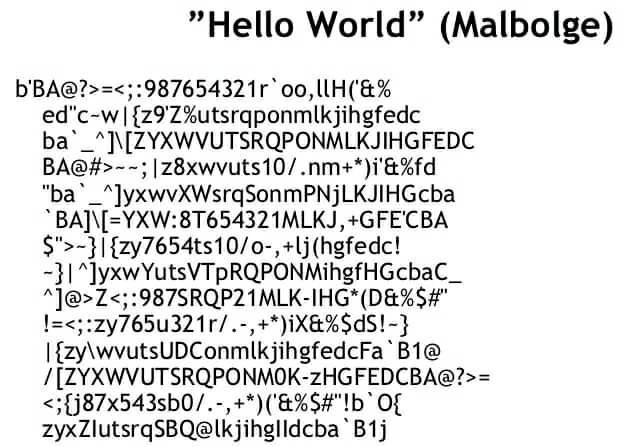
Malbolge was created to be hard. The name pulls from Dante’s Inferno. It uses self-modifying code. Instructions change after they run. The encoding is twisted. Even a simple Hello World was first found by search, not by hand. This is why many call Malbolge the most difficult coding language.
What makes it so brutal?
- The instruction set is obfuscated. You do not get a simple map from character to action.
- After running an instruction, the code mutates. Your program shifts under your feet.
- There is minimal tooling and few examples. You learn by pain and patience.
I once tried to trace a Malbolge sample for an hour. I only mapped a few steps. My takeaway: it is art, not a tool. If your goal is to ship software, do not start here. If your goal is to explore the edges of computation, Malbolge is the most difficult coding language you can touch.

The most difficult coding language for real-world work
Most readers want a practical answer. For actual projects, three languages often feel like the most difficult coding language.
- C++. The power is huge. So are the footguns. You juggle memory, templates, exceptions, and undefined behavior. The standard is vast. A small mistake can crash production. I have shipped C++ in finance. The performance was great. The debugging was not. Strong coding standards and static analysis tools are a must.
- Rust. The compiler is strict because it keeps you safe. Ownership, borrowing, and lifetimes bend your mind at first. But once it clicks, you write safe, fast code. When I moved a C++ module to Rust, bugs dropped. Build times rose. My advice is to learn ownership with tiny examples before you touch async or traits.
- Haskell. Pure functions and lazy evaluation change how you think. The type system is a superpower. But it has a steep slope. You need to learn patterns like functors, monads, and algebraic data types. I once rewrote a data pipeline in Haskell. The code was short and clear. The learning time was long. The payoff came in fewer runtime bugs.
In a business sense, many teams call C++ or Rust the most difficult coding language. It depends on your team, deadlines, and risk tolerance.

How to judge difficulty with a simple framework
Use this quick test to judge the most difficult coding language for you.
- Time to first win. Can you print text or parse a file in one hour?
- Error clarity. Do you understand compiler errors without deep searches?
- Tooling strength. Do you get autocomplete, linting, and a good debugger?
- Concept shift. Does the language demand a new mental model?
- Maintenance cost. Will future changes be safe and easy?
Score each item from 1 to 5. Add them up. A higher total means it may feel like the most difficult coding language for your needs. This simple frame has saved me from bad bets more than once.
Practical examples: what “hard” looks like
Let’s map the pain to real tasks. This helps you see why one might be the most difficult coding language in a given case.
- Memory control in C++. You free memory wrong. It crashes later, not now. Tool up with sanitizers and smart pointers.
- Borrow checker in Rust. The compiler blocks a move or a borrow. The fix is to refactor data flow. Aim for clear ownership lines.
- Lazy evaluation in Haskell. A large thunk builds and eats RAM. Use strictness where needed. Profile early.
- APL array thinking. One symbol can map, reduce, and reshape. It is powerful. It is also dense. Write comments and expand steps at first.
- Brainfuck pointer tracking. A loop shifts the pointer. You lose track. Use a data tape diagram to think step by step.
These examples show why a task can turn a tool into the most difficult coding language for your project.
How to learn a difficult programming language faster
You can beat the curve with a simple plan. This works no matter which one you see as the most difficult coding language.
- Learn the mental model first. Draw diagrams. Explain it in your own words.
- Start tiny. Make micro programs. Use one new feature at a time.
- Read great code. Pick small, idiomatic repos. Copy patterns.
- Use the right tools. Linters, formatters, and IDE hints cut time.
- Build a real mini project. A CLI tool or a small service works well.
- Write tests early. Tests document behavior and save your sanity.
- Ask for code reviews. A short review teaches more than a long blog post.
I used this plan to go from zero to shipping Rust in a few weeks. The first week was only experiments. Week two was a small CLI. Week three was a service skeleton. The pace felt slow. But the base was strong.
Common mistakes to avoid when tackling the most difficult coding language
Avoid these traps. They can turn a hard task into a painful one.
- Skipping basics. You jump to advanced topics. The core ideas never click. Slow down to speed up.
- Copying patterns from other languages. It leads to awkward code. Learn the idioms of the target language.
- Ignoring docs and compiler hints. Modern compilers teach you. Read the errors. They point to the fix.
- Big bang rewrites. Migrate in small steps. Keep risk low.
- Not using community channels. Forums and chats cut time. Ask clear, small questions.
These habits help you win even when you face the most difficult coding language at work.
Career impact: when choosing a hard language pays off
Picking a tough language can boost your career. The most difficult coding language for a domain often guards higher leverage roles.
- Systems and infra. Rust and C++ open doors to OS, DB, and low-latency work.
- Finance and gaming. C++ skill still pays well in these fields.
- Data at scale. Haskell and APL shine in niche, high-value teams.
- Reliability at scale. Erlang/Elixir experts keep systems alive under load.
I have seen engineers triple their impact by moving to tough stacks. The key is to pick the right pain. Choose a language that matches your interests and the market you want.
Balanced verdict: which is the most difficult coding language?
If we mean by design, Malbolge is the most difficult coding language. It is art and puzzle, not a tool. If we mean for real products, C++, Rust, and Haskell are strong answers. The right answer depends on your goal, your team, and your time. Use the framework above and test before you commit.
Frequently Asked Questions of most difficult coding language
Why do people call Malbolge the most difficult coding language?
It mutates its own code and uses twisted encodings. Even simple programs are hard to write and reason about.
Is Rust the most difficult coding language to learn today?
Rust is tough at first due to ownership and borrowing. Once it clicks, many find it easier to maintain than C++.
Is Haskell harder than C++?
It depends on your background. Haskell’s math-heavy style is new to many, while C++ has many features and pitfalls.
Which “hard” language should I learn for better jobs?
Pick based on domain. Rust and C++ for systems, Haskell for robust data pipelines, APL for niche analytics.
Can I learn the most difficult coding language without a CS degree?
Yes. Use small steps, good docs, and practice projects. Patience and a plan matter more than a degree.
Conclusion
Hard languages reward focus. If you chase the most difficult coding language, be clear on why. Choose the right kind of hard for your goals. Start small, learn the mental model, and use great tools. With steady practice, the “impossible” becomes routine. Try a tiny project this week, share your code for review, and build your skills step by step. If this guide helped, subscribe for more deep dives or leave a comment with your next language challenge.